
One month ago, we reported on Democratic senator Maria Cantwell asking U.S. Trade Representative Katherine Tai about Sony’s business practices. While we reported this under the context of Sony unwittingly drawing attention to themselves, we didn’t actually see video of the hearing, until now.
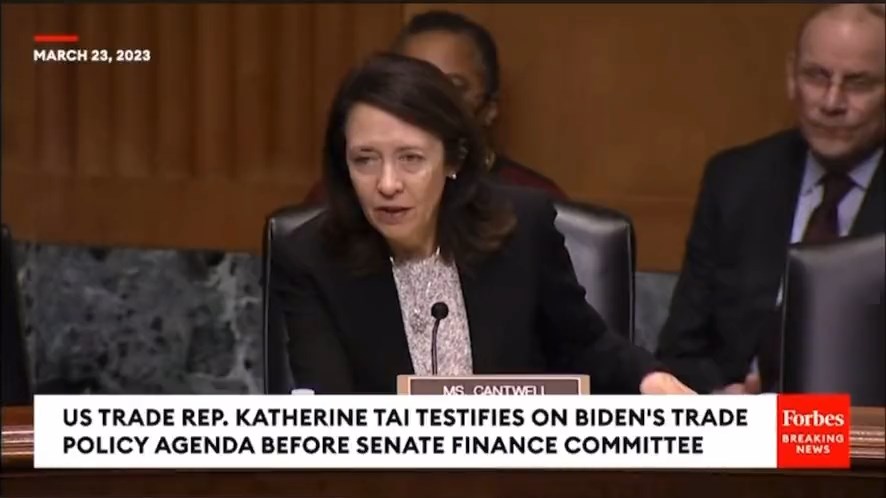
As shared by PostUp_SOG, here’s the clip of Senator Cantwell asking Representative Tai, as well as Representative Tai’s response. This happened one month ago, during the Senate Finance Committee Hearing about Biden’s Trade Policy Agenda.
While we are sharing the clip here, you can also read a transcript of the exchange below. We have also edited it for clarity.
“Cantwell: I’m told that Sony controls a monopoly of 98% of the high-end game market, yet Japan’s government has allowed Sony to engage in blatant anti-competitive conduct through exclusive deals and payments to game publishers, establishing games that are among the most popular in Japan, not to distribute the games on other platforms.
And so, Japan’s FTC has failed to investigate this exclusionary conduct. So, what do you think we can do to address these issues and create a level playing field with the IPEF (Indo-Pacific Economic Framework) on something as important as this issue.
Tai: Senator Cantwell, the Indo-Pacific Economic Framework provides us with a lot of opportunities. I think you are absolutely right that the countries we are engaging with right now are all focused on expanding participation in their economies, and looking at trade policies that also promote and support competition. So, we have that particular outlook.
We also have an ongoing digital negotiation as well. What you’ve described is something, I expect, may very well come up, in the intersection of those two perspectives: being pro-competition and also engaging on the digital economy.
That is absolutely an area that we are primed to address. This one is new for me, but let me take this back, and I’m happy to follow up with you and your team on this.
Cantwell: If they were blocking access, would that be of grave concern?
Tai: If they were or are they?
Cantwell: I’d say they are. But you said you were looking into this, to be clear do you see this as a problem?
Tai: Yes, I think monopolist behavior is a drag on economic growth and development.
Cantwell: Thank you. Thank you, Mr. Chairman.”
The Indo-Pacific Economic Framework is a trade agreement between the US and 14 countries in the Indo-Pacific, which includes Japan, as well as India, Australia and South Korea. You can read more about it here and here. What’s important to know here is that Senator Cantwell has directed Rep. Tai to use the trade agreement as an opportunity to talk to the Japanese government about these concerns.
Most observers are in agreement that Sony drew attention to their own behavior, when they lobbied with different regulators to block the Microsoft Activision deal.
However, the issue that various US senators and congresspeople, from both parties, are addressing now has nothing to do with that deal. While they also use the language of ‘high-end game console market’, that also is not that important in the long run.
The question here is in regards to Sony signing up third party exclusives, and if their continued behavior in this regard should be considered monopolistic or anti-competitive.
That was a different question in the 1990s and early 2000s when Sony was still gaining a foothold in the game console market. While it’s true that they had been dominant in both console generations, the market conditions at the time still encouraged third party developers like EA and Activision to make their games multiplatform.
Today, there is no question that Sony dwarfs Microsoft in this market. Nintendo’s indirect competition strategies may obscure how successful they are against Sony, but it is also true that many third party games that could have released on Nintendo platforms did not make that trip because of Sony exclusivity.
For example, the Castlevania Requiem release from 2018, bundling the PSP versions of Symphony of the Night and Dracula X Chronicles, was exclusive to the PlayStation 4 upon release. That marks 26 years that Symphony of the Night has never seen release on a Nintendo platform, and 19 years since Dracula X Chronicles has never been released on a Nintendo platform as well.
Now, sometimes making a third party game exclusive to a console can be justified. For example, when Square Enix says Final Fantasy 16 is built around the PlayStation 5’s SSD speed, that is an argument that focusing on one platform is allowing Square Enix to make it as best a game as can be.
However, if you look at this case in the sense of Sony having monopolistic practices, it looks completely different. These practices allow Sony to say, for example, that they will always have all the Castlevania games, and Nintendo won’t get to say the same.
On another end, it’s precisely the fact that Sony has been so successful with their third party exclusive strategy that their actions can go up for scrutiny. And that can mean practices like paying for third party exclusives, and it can also mean acquiring other game studios as well.
This is no longer a situation where the consumer is the ultimate arbiter of a free market, where gamers get the final choice if Sony, Microsoft, or Nintendo is the best company to deserve the most sales. Video games are now such a big industry, and such a source for American jobs, that they are now up for scrutiny and regulation to protect those US jobs, and American employees.
In other words, other stakeholders are making their voices heard on the industry, and gamers won’t necessarily get what they think is best for them, when these other stakeholders have their say.